Beyond the Bounce-Back: What 2025’s AmLaw Lateral Market Means for 2026
By The Standard Legal Recruiting
All data below is sourced from the Firm Prospects 2025 AmLaw Lateral Hiring Report.
In 2025, the lateral market regained momentum across all attorney levels, reaching its strongest hiring totals since the post‑pandemic peak, but in a far more disciplined form. Partner hiring hit a five‑year high, counsel hiring reached the highest level in the report’s period, and associate hiring continued stabilizing after the 2023 correction.
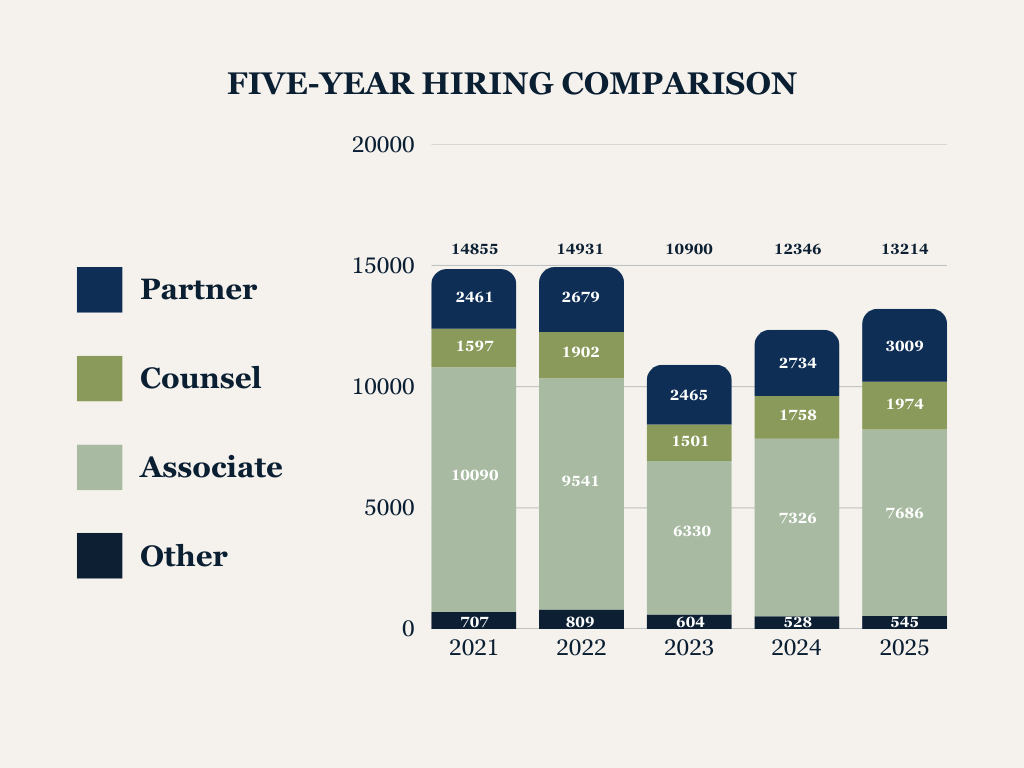
Graphic data from Firm Prospects 2025 AmLaw Lateral Hiring Report
Beneath that rebound, activity concentrated in clear lanes: corporate and financial services groups began rebuilding after sluggish years in 2023 and 2024; regulatory and enforcement practices expanded as attorneys exited federal agencies; and several secondary markets posted lateral activity well above historical norms, positioning them as markets to watch.
Top Takeaways:
Renewed hiring confidence – 2023 and 2024 proved to be uneven and inconsistent when it came to lateral hiring. In 2025 we saw a change of pace, with lateral hiring increasing at all levels (associate, counsel, and partner). Notably, both partner and counsel hiring reached their highest levels in the last five years.
This wasn’t a broad hiring spree like we saw post-pandemic – and that is a good thing. Instead, firms selectively rebuilt practice groups that were scaled back during the 2023 overcorrection, a sign of law firm confidence in the market in 2025 that is continuing into the new year.
Litigation led the way, but the story is transactional – Litigation once again accounted for the largest share of hiring at all levels. This has been consistent over the past five years and therefore not an indication of market conditions on its own. Interestingly, the overall share of litigation moves eased from roughly 34% in 2024 to 31% in 2025, even as total lateral hiring increased. This change signals that firms were no longer hiring solely to manage disputes and regulatory risk, but to prepare for increased deal and transactional activity: a sign of a rebounding market.
Firms invested across the core engines of associate workflow: corporate, labor & employment, banking, real estate, and IP all saw substantial associate hiring, each contributing enough volume to show that firms expect sustained demand into 2026, rather than short‑term spikes.
At the partner level, firms put clear emphasis on rebuilding their transactional and finance‑adjacent benches: corporate was the second‑largest practice for partner hires, and banking and finance activity held steady, suggesting firms were preparing for a stronger deal cycle ahead.
Government as a feeder to AmLaw & Counsel – One of the clearest features of 2025 was the flow of attorneys leaving federal agencies for private practice. Government sources, including the DOJ, U.S. Attorney’s Offices, SEC, and IRS, accounted for a meaningful share of senior lateral moves in 2025, with counsel hires leading the way. This trend reflects firms’ appetite for seasoned regulatory attorneys and their preference to deepen benches without expanding partnership ranks.
While the highs of 2025 may not carry forward, this trend is unlikely to be isolated. The report’s 2026 outlook anticipates heightened enforcement, class actions, antitrust activity, and AI‑related regulatory work, all of which point to continued lateral movement from federal agencies into private practice.
Secondary markets gain momentum – While the perennial hiring leaders remain New York and Washington, D.C., secondary markets showed notable strength in 2025. Denver emerged as one of the strongest secondary markets nationwide, with its counsel-level hiring placing it in the national top-tier despite its size.
Meanwhile, Texas, particularly Dallas and Houston, posted some of the highest associate hiring volumes outside New York and D.C., making it the strongest secondary market in the U.S. for AmLaw associate movement. Together, these trends reflect firms’ growing confidence and deliberate investment in building depth beyond the coasts.
Is that the same list? – Many firms appear on both the “top hires” and “top departures” lists, underscoring how fluid lateral movement has become across the AmLaw 200. Attorneys are prioritizing fit more than ever: culture, practice alignment, and long-term opportunity play a central role in lateral decisions. As talent circulates more quickly, firms that recruit with precision and market intelligence, rather than urgency alone, are better positioned to turn movement into durable, long-term growth.
The 2025 lateral market did more than rebound, it set the trajectory. Firms rebuilt transactional depth, leveraged the counsel track to support regulatory and employment-driven demand, and made intentional investments across both primary and secondary markets.
Looking ahead, the foundation for 2026 is firmly in place. Transactional work has regained momentum, litigation demand remains consistent, and firms are approaching hiring with clearer, longer-term priorities. This creates a market defined less by reaction and more by strategy.
For attorneys considering a lateral move, 2026 offers more targeted roles, stronger platforms, and opportunities aligned with sustainable growth. It is a market positioned for confidence – and an ideal moment for attorneys to move with intention.